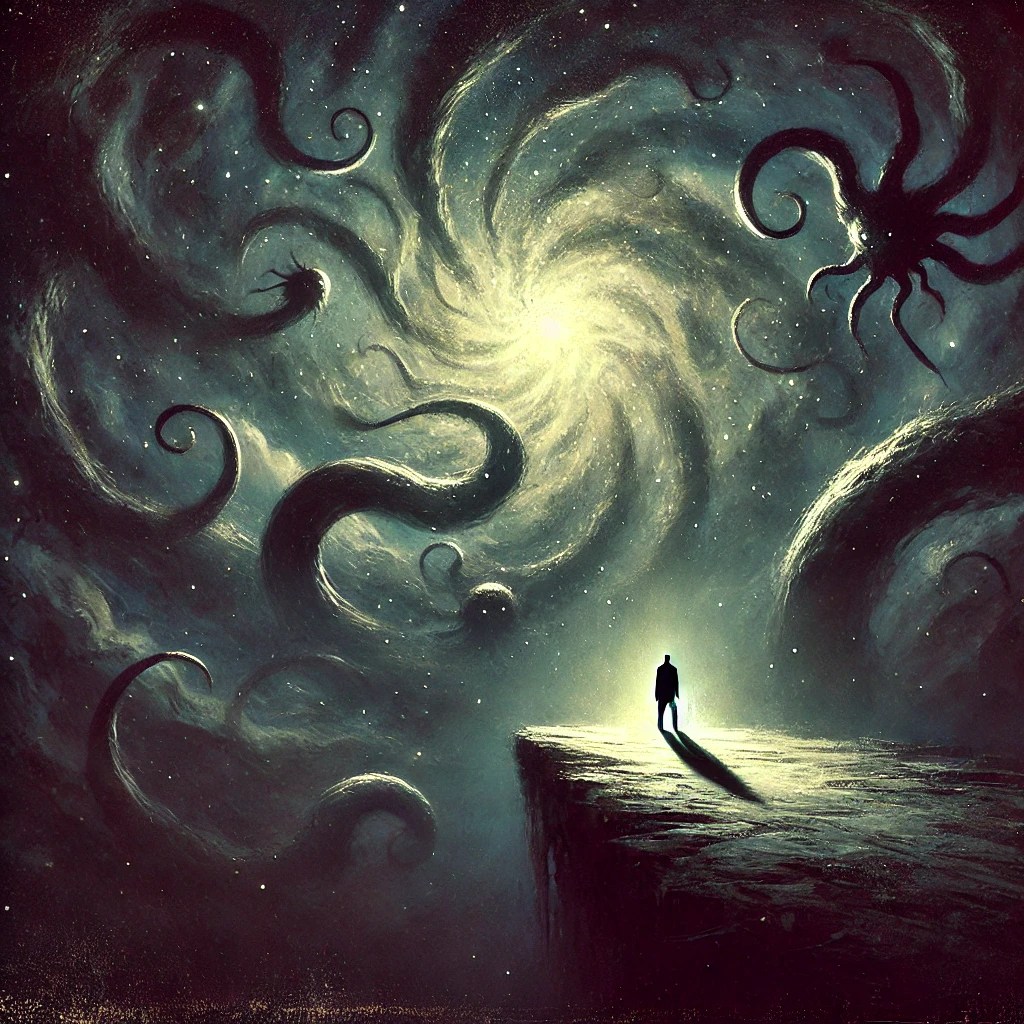
Fear has been a defining force in human history—a primal emotion that shapes our understanding of the world. From ancient civilizations attributing natural disasters to gods to modern explorations of existential dread, fear remains deeply rooted in the unknown.
No writer encapsulated this concept more than H.P. Lovecraft, whose philosophy of Cosmicism introduced the idea that the universe is vast, indifferent, and utterly beyond human comprehension. Through his Cthulhu Mythos, Lovecraft redefined horror—not through traditional monsters, but by confronting humanity with the terrifying realization that we are insignificant specks in a boundless cosmos.
By exploring Lovecraft’s literary themes, biographical influences, and philosophical underpinnings, we gain insight into how the fear of the unknown continues to shape literature, psychology, and existential thought.
The Historical Roots of Fear
🌌 From Myth to Science: The Evolution of the Unknown
Since the dawn of civilization, humans have sought explanations for the chaotic and unpredictable forces of nature.
- Ancient Greeks personified natural disasters as wrathful gods, believing divine intervention controlled their fate.
- Medieval thinkers associated the unknown with demons and supernatural entities, reinforcing religious explanations of fear.
- The Enlightenment brought scientific reasoning, yet fear persisted—no longer directed at vengeful gods, but at the vast, impersonal universe revealed by science.
Lovecraft’s work reflects this shift, portraying cosmic horror as the ultimate fear—not of gods or demons, but of a universe so vast and indifferent that human existence becomes meaningless.
Lovecraft’s Philosophy: Cosmicism and the Fear of Insignificance
🎭 What is Cosmicism?
At the heart of Lovecraft’s work is Cosmicism, a philosophy that rejects the idea of human importance in the universe. Unlike traditional horror, which focuses on personal threats (ghosts, monsters, murderers), Lovecraft’s horror stems from existential dread—the realization that the universe does not recognize, nor care about, human existence.
- There is no divine order or purpose.
- Human perception is too limited to comprehend reality.
- The pursuit of knowledge can lead to madness, as some truths are too overwhelming.
In this way, Lovecraft shatters the comforting notion that humans are central to existence, forcing readers to confront the possibility that they are insignificant cosmic accidents.
📖 Madness as the Price of Knowledge
One of Lovecraft’s most haunting themes is the idea that forbidden knowledge leads to madness. His protagonists—often scholars, scientists, or explorers—seek to uncover hidden truths but are inevitably driven to insanity by what they discover.
This suggests that:
- Curiosity is a double-edged sword—seeking truth may come at the cost of sanity.
- Some knowledge is best left unknown, as the human mind may not be equipped to handle ultimate reality.
- Ignorance, in some cases, may be bliss, protecting us from existential despair.
This theme appears in stories such as The Call of Cthulhu and At the Mountains of Madness, where uncovering cosmic secrets results in psychological collapse.
The Influence of Lovecraft’s Life on His Work
🏛️ Personal Trauma and the Origins of Alienation
Lovecraft’s fiction is deeply influenced by his own struggles with anxiety, isolation, and family trauma.
- His father’s institutionalization for psychosis and his mother’s overprotectiveness left him withdrawn from society.
- He experienced extreme xenophobia and fears of the “Other,” which manifested in his writing as monstrous, incomprehensible beings.
- His financial struggles and failures fueled his sense of insignificance, mirroring the themes of helplessness in the face of an indifferent universe.
Understanding Lovecraft’s biography adds depth to his stories, revealing how his personal fears translated into cosmic horror narratives.
The Cthulhu Mythos: Cosmic Horror in Fiction
🌊 Beyond Monsters: Entities Beyond Comprehension
Lovecraft’s greatest literary innovation was the creation of alien deities that do not conform to human morality or logic. Unlike traditional horror creatures (vampires, werewolves, demons), Lovecraft’s beings:
- Do not care about humanity—they exist independently of us.
- Are not inherently good or evil—human concepts of morality do not apply to them.
- Cause madness simply by being perceived, as their forms and nature defy human logic.
Some of his most famous entities include:
- Cthulhu – A sleeping god beneath the ocean, whose mere presence in human dreams induces insanity.
- Nyarlathotep – A shape-shifting trickster who interacts with humanity but manipulates them toward destruction.
- Yog-Sothoth – A being outside time and space, representing the unfathomable nature of reality itself.
These beings reinforce Lovecraft’s theme that the true horror is not death, but irrelevance—humanity is not at the center of the universe, and there are forces beyond our control or comprehension.
Dreams, Non-Euclidean Geometry, and the Subconscious
🌀 How Lovecraft Uses the Unknowable to Create Fear
Lovecraft employed several unique literary techniques to instill a sense of unease and fear:
- Non-Euclidean Geometry – His descriptions of architecture and landscapes defy normal physics, creating spaces that “should not exist.”
- Dream Narratives – Many of his stories take place in surreal, nightmarish dreamscapes, where reality is fluid and unknowable.
- First-Person Horror – His stories often feature diary entries or fragmented reports, making the reader experience the descent into madness firsthand.
By using these techniques, Lovecraft immerses the reader in disorientation, mimicking the feeling of confronting something truly alien.
Key Takeaways
- 🌌 Fear of the Unknown is the most ancient and persistent human emotion, shaping our beliefs and behaviors.
- 📖 Lovecraft’s Cosmic Horror redefined fear, shifting it from supernatural elements to the terrifying vastness of an indifferent universe.
- 🏛️ His personal struggles with isolation and anxiety informed his themes of alienation and insignificance.
- 🧠 Madness results from knowledge, suggesting that some truths are too overwhelming for human understanding.
- 🌊 The Cthulhu Mythos embodies existential dread, showing that humanity is insignificant in the cosmic order.
- 🌀 Dreams and bizarre geometries create an immersive horror experience, challenging human perception of reality.
The Bigger Picture
Lovecraft’s ideas continue to influence literature, film, and philosophy, from Stephen King’s horror novels to modern discussions on existentialism and cosmic nihilism. His work invites us to reflect on our place in the universe—to question whether we are truly central to existence or merely momentary flashes in an uncaring cosmos.
Ultimately, Lovecraft’s horror forces us to confront an uncomfortable truth:
- The universe does not owe us meaning.
- The unknown will always exist beyond our grasp.
- And perhaps, the most terrifying realization of all—is that we are utterly insignificant.
Yet, within this fear lies a strange kind of freedom—an opportunity to embrace the mystery, find our own meaning, and exist in defiance of the vast, unknowable abyss. 🌌


 alter your perspective
Leave a comment