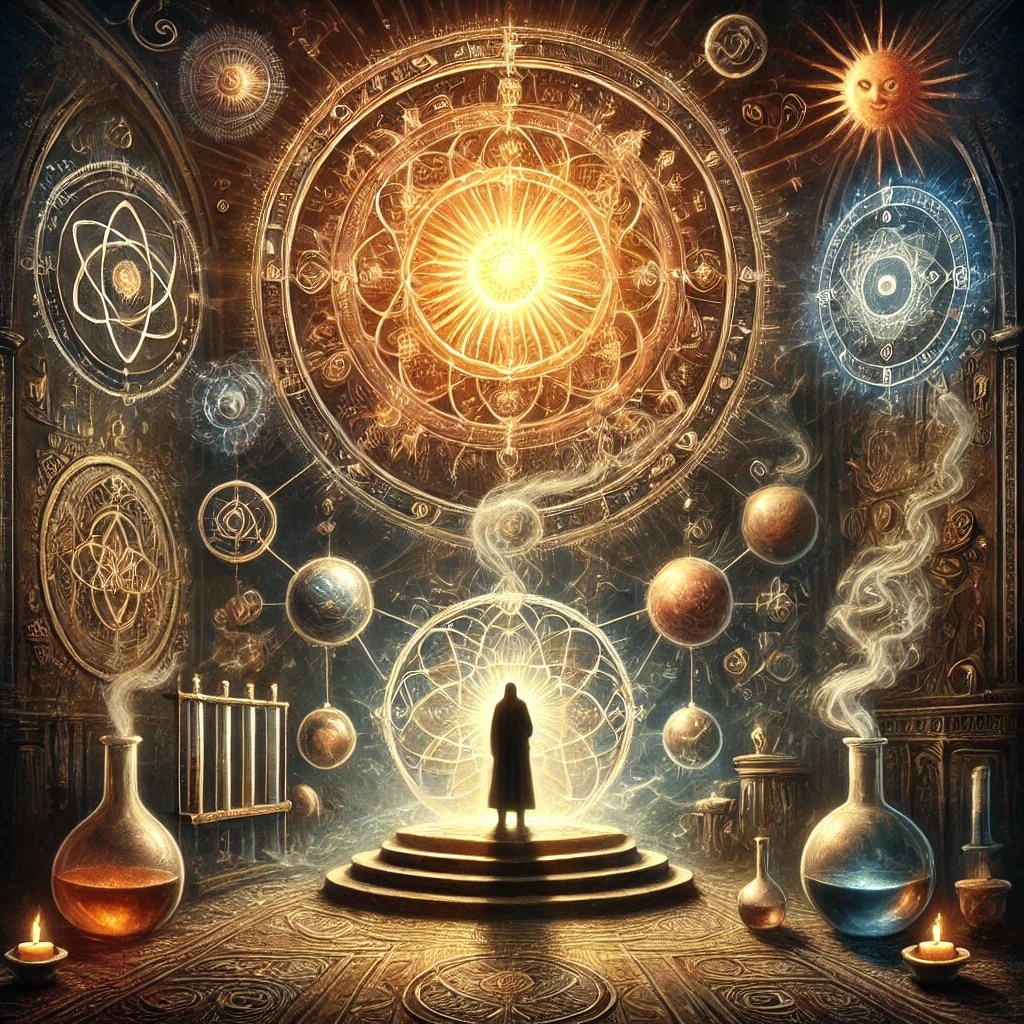
Alchemy, often dismissed as an outdated precursor to modern chemistry, holds profound symbolic and psychological significance. Through the lens of Carl Jung’s analytical psychology, alchemy emerges as a powerful metaphor for inner transformation, representing the journey toward self-realization and wholeness.
Rather than focusing on turning lead into gold, the true alchemical work—the Magnum Opus—is an inner process of psychological refinement, where one confronts their shadow, integrates opposites, and achieves individuation. This article explores alchemy’s historical, symbolic, and psychological dimensions, illustrating how its teachings remain relevant for personal growth today.
Alchemy as a Symbolic Language of the Psyche
🧙♂️ Ancient Wisdom Meets Modern Psychology
Alchemy has long been associated with mystical and esoteric traditions, blending science, philosophy, and spirituality. While early alchemists sought physical transmutation, Jung discovered that alchemical texts and symbols align with the processes of the unconscious mind, making alchemy an early form of depth psychology.
He proposed that the operations of alchemy—calcinatio, solutio, and coniunctio—represent stages of individuation, the process by which we integrate all aspects of the self to achieve inner balance.
🌌 The Collective Unconscious and Archetypes
Jung believed that alchemical symbols arise from the collective unconscious, mirroring the archetypal processes of transformation that every human undergoes. Alchemy, therefore, serves as a map of the psyche, guiding individuals through the stages of inner purification and renewal.
By engaging with these symbols—whether through dreams, active imagination, or personal introspection—individuals can unlock deeper aspects of their unconscious mind and accelerate their psychological growth.
The Alchemical Process as Inner Transformation
Each stage of alchemy symbolizes a critical step in psychological development, reflecting the trials and transformations necessary to reach wholeness.
🔥 Nigredo (The Blackening) – Confronting the Shadow
- Represents dissolution, decay, and darkness—a necessary breakdown of old identity structures.
- Psychological meaning: Facing our shadow (the repressed, hidden parts of ourselves).
- Jungian insight: True transformation requires acknowledging our flaws, fears, and unconscious motivations.
This stage is often accompanied by existential crises, emotional turmoil, or depression, but it is a crucial initiation into deeper self-awareness.
💧 Albedo (The Whitening) – Purification and Insight
- Symbolizes renewal, clarity, and the first glimpse of transformation.
- Psychological meaning: Integrating new awareness, refining emotions, and shedding illusions.
- Jungian insight: A period of insight, where we begin to recognize patterns in our psyche and cultivate a more authentic self.
At this stage, individuals start making peace with their inner conflicts, fostering clarity and self-acceptance.
⚖️ Citrinitas (The Yellowing) – Integration of the Higher Self
- Represents wisdom, intellectual enlightenment, and the emergence of a new vision.
- Psychological meaning: Uniting reason and intuition, aligning personal truths with action.
- Jungian insight: A realization that our higher potential is not found in rejecting the material world, but in integrating spiritual and earthly dimensions.
This is the stage of individuation, where we synthesize all previous insights into a cohesive and empowered sense of self.
🌟 Rubedo (The Reddening) – The Union of Opposites
- Symbolizes completion, the philosopher’s stone, and the ultimate realization of wholeness.
- Psychological meaning: The final unification of conscious and unconscious, masculine and feminine, self and shadow.
- Jungian insight: True enlightenment comes not from rejecting darkness but from embracing and transforming it into wisdom.
This stage represents psychological rebirth, where individuals emerge as whole, individuated beings, free from inner fragmentation.
Key Psychological Insights from Alchemy
🌀 Alchemy as a Mirror of the Human Psyche
Alchemy provides a structured framework for self-exploration, showing how human transformation is a cyclical process—one must endure destruction before renewal, darkness before enlightenment.
By engaging with symbolic imagery, we can decode the unconscious messages hidden within dreams, emotions, and creative impulses, leading to profound self-discovery.
🌓 The Integration of Opposites – The Sacred Marriage
One of the most vital themes in alchemy is the union of opposites—the coniunctio oppositorum. This mirrors Jung’s idea of individuation, where true self-realization requires integrating:
- The masculine and feminine aspects of the psyche.
- The conscious and unconscious mind.
- The material and spiritual dimensions of existence.
Rather than eliminating contradiction, alchemy teaches us to embrace paradox, recognizing that wholeness arises from synthesis, not division.
🔥 Transformation Through Crisis
- The nigredo stage reminds us that pain and disintegration are necessary for growth.
- The purification of albedo teaches detachment from illusions.
- The final union in rubedo affirms that embracing the totality of our being leads to self-liberation.
This symbolic death and rebirth is a universal process, found in myth, religion, and personal transformation.
Alchemy’s Relevance in Modern Life
Despite its ancient origins, alchemy offers valuable insights for contemporary seekers of personal and spiritual growth.
- Therapeutic Applications: Jungian analysts use alchemical imagery in therapy to help clients navigate psychological crises.
- Dream Work: Engaging with dream symbols as alchemical stages provides a structured way to interpret the unconscious.
- Creativity & Expression: Many artists, writers, and thinkers have drawn upon alchemical imagery to express the process of personal transformation.
- Spiritual Practice: Alchemy aligns with meditative, mystical, and inner work traditions, reinforcing the importance of self-reflection.
Rather than being an archaic pseudo-science, alchemy offers a profound psychological roadmap for those willing to embark on the journey of self-exploration and transformation.
Conclusion: The Philosopher’s Stone is Within
Alchemy is more than a historical curiosity—it is a living tradition of self-transformation, bridging ancient wisdom and modern psychology. Through its rich symbolism and structured stages, alchemy teaches that true gold is found not in external wealth but in inner wholeness.
“As above, so below; as within, so without.”
The great work of alchemy invites us to descend into our depths, confront our shadows, and emerge as something greater. The path is neither easy nor linear, but for those who embark on it, the rewards are nothing short of the philosopher’s stone—the discovery of the true self.



 alter your perspective
Leave a comment