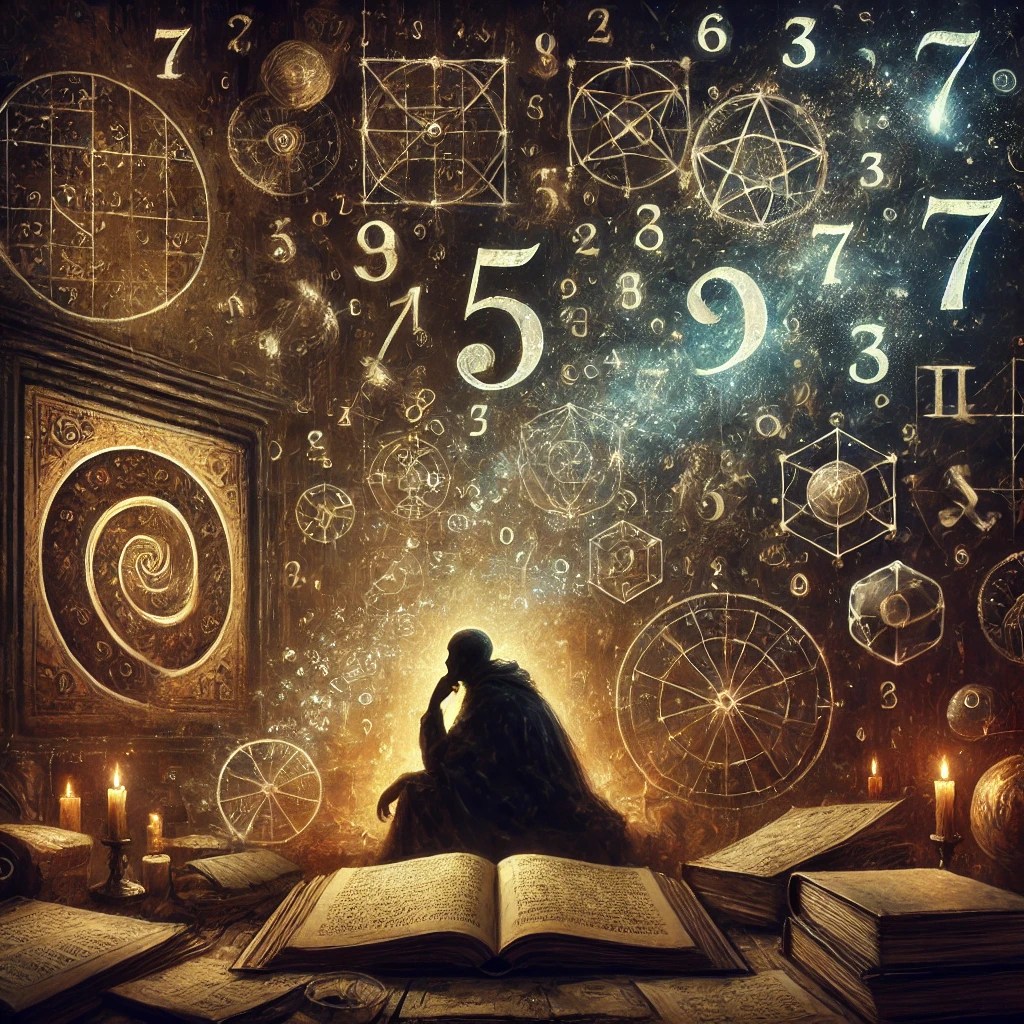
Numbers are more than mere mathematical constructs; they hold deep psychological, spiritual, and philosophical significance. Across history, numbers have been seen as universal archetypes, guiding human thought, shaping cultural beliefs, and influencing the very fabric of reality.
From Pythagoras’ mystical number theory to Carl Jung’s exploration of numerical symbolism in the collective unconscious, numbers have been revered as both measurable quantities and profound metaphysical symbols. They bridge the gap between the material and the immaterial, offering insights into the structure of the psyche, synchronicity, and the interconnected nature of existence.
Numbers as Archetypal Symbols
📜 The Ancient and Esoteric Foundations of Numbers
Long before numbers were used for commerce or calculation, ancient civilizations assigned them sacred meanings.
- Pythagoras, the Greek philosopher, viewed numbers as divine principles that govern the universe, believing that mathematical relationships reflect the order of nature and the cosmos.
- Isopsephy and Gematria, numerical systems used in Greek and Hebrew traditions, assigned numbers to letters, uncovering hidden meanings in sacred texts and words.
- Eastern traditions recognized numerical symbolism in Taoist philosophy, the I Ching, and Buddhist cosmology, illustrating the universal nature of numbers as spiritual guides.
Numbers have long been interpreted as both discovered and invented, suggesting that they exist independently of human perception while also shaping human thought.
🌌 Jung’s Perspective: Numbers as Archetypes of the Unconscious
Carl Jung proposed that numbers emerge from the collective unconscious, representing fundamental patterns of thought and experience.
- Numbers appear spontaneously in dreams, myths, and synchronicities, guiding individuals through inner transformation.
- The progression of numbers reflects psychological development, marking key stages in the journey toward self-integration and individuation.
- The concept of unus mundus—the unity of psyche and matter—suggests that numbers act as bridges between the inner and outer worlds, reinforcing their role in meaningful coincidences.
This perspective highlights how numbers hold both personal and universal significance, shaping self-awareness and guiding human destiny.
The Symbolic Meaning of Numbers in Personal Growth
Each number carries distinct psychological and philosophical attributes, reflecting different stages of consciousness and transformation.
1️⃣ Unity and the Self
- Represents individuality, beginnings, and divine singularity.
- Symbolizes the monad, the undivided whole from which all things originate.
- In psychology, it signifies the emergence of self-awareness and personal identity.
2️⃣ Duality and Opposition
- Embodies polarity, relationships, and contrast (light/dark, male/female, conscious/unconscious).
- Reflects the necessity of conflict and balance in personal and cosmic evolution.
- In Jungian terms, it represents the tension of opposites that must be reconciled for growth.
3️⃣ Harmony and Creativity
- Symbolizes creation, movement, and synthesis, often associated with the trinity in religious and mythological traditions.
- Represents the integration of opposites into a higher unity, seen in psychological development as a step toward individuation.
- Suggests expression, intuition, and expansion, marking the transition from duality to dynamic creation.
4️⃣ Stability and Wholeness
- The number of completion, structure, and grounded reality (four elements, four seasons, four directions).
- In Jungian thought, fourfold structures appear in dreams and mandalas, symbolizing psychic wholeness.
- Represents order in the material world, reflecting the need for stability before transformation.
These four primary numbers form the foundation of numerical symbolism, shaping our understanding of life, self, and the natural world.
Numbers, Synchronicity, and the Hidden Order of Reality
🔄 Numbers and Meaningful Coincidences
Jung observed that numbers often appear in synchronistic events, reinforcing their role as messengers of hidden meaning.
- People repeatedly encountering a specific number at crucial moments may experience it as a signal from the unconscious.
- Numerical patterns in dreams can reveal underlying psychological themes, offering guidance and insight into personal dilemmas.
- The recurrence of certain numbers in historical, religious, and scientific discoveries suggests that numbers may structure reality beyond mere chance.
The interplay between mathematical precision and personal meaning raises questions about whether numbers exist independently or emerge from consciousness itself.
🕊️ The Role of Numbers in Spiritual and Philosophical Thought
Beyond individual psychology, numbers govern cosmic and metaphysical systems, appearing in:
- Sacred geometry, which links mathematical patterns to the structure of the universe.
- Platonic philosophy, where numbers are viewed as eternal forms that underpin reality.
- Modern physics, where numbers dictate the fundamental laws of space, time, and energy.
This intersection suggests that numbers serve as a universal language, revealing the hidden connections between mind, matter, and meaning.
The Psychological and Philosophical Power of Numbers
🌟 Numbers as Pathways to Self-Knowledge
Engaging with numerical symbolism can:
✅ Deepen self-awareness by revealing unconscious patterns.
✅ Provide clarity and guidance through recurring numerical synchronicities.
✅ Connect personal experiences to universal truths, enriching our understanding of reality.
🔮 Higher Numbers and Cosmic Patterns
Beyond 1-4, higher numbers reflect expanded states of consciousness:
- 5 – Change, freedom, and dynamic movement.
- 6 – Harmony, balance, and integration of opposites.
- 7 – Spiritual insight, mystery, and hidden knowledge.
- 8 – Power, material mastery, and karmic cycles.
- 9 – Completion, wisdom, and transcendence.
- 10 – Return to unity, the completion of one cycle and the beginning of another.
Each number carries symbolic significance that guides both individual transformation and cosmic understanding.
Conclusion: The Hidden Intelligence of Numbers
Numbers are more than tools for counting; they are archetypal symbols that shape consciousness, structure reality, and guide personal transformation. From ancient numerology to modern psychology, numbers reveal the universal principles of order, chaos, and evolution.
Through the insights of Pythagoras, Jung, and modern physics, we recognize numbers as both constructs of the mind and fundamental aspects of existence. Their recurrence in dreams, synchronicities, and mystical traditions suggests that they function as keys to deeper understanding.
By paying attention to the numbers that appear in our lives, we can develop a greater awareness of the hidden forces shaping our journey, ultimately discovering that:
Numbers are not just measurements—they are messages, guiding us toward greater wholeness, meaning, and connection with the universe.


 alter your perspective
Leave a comment