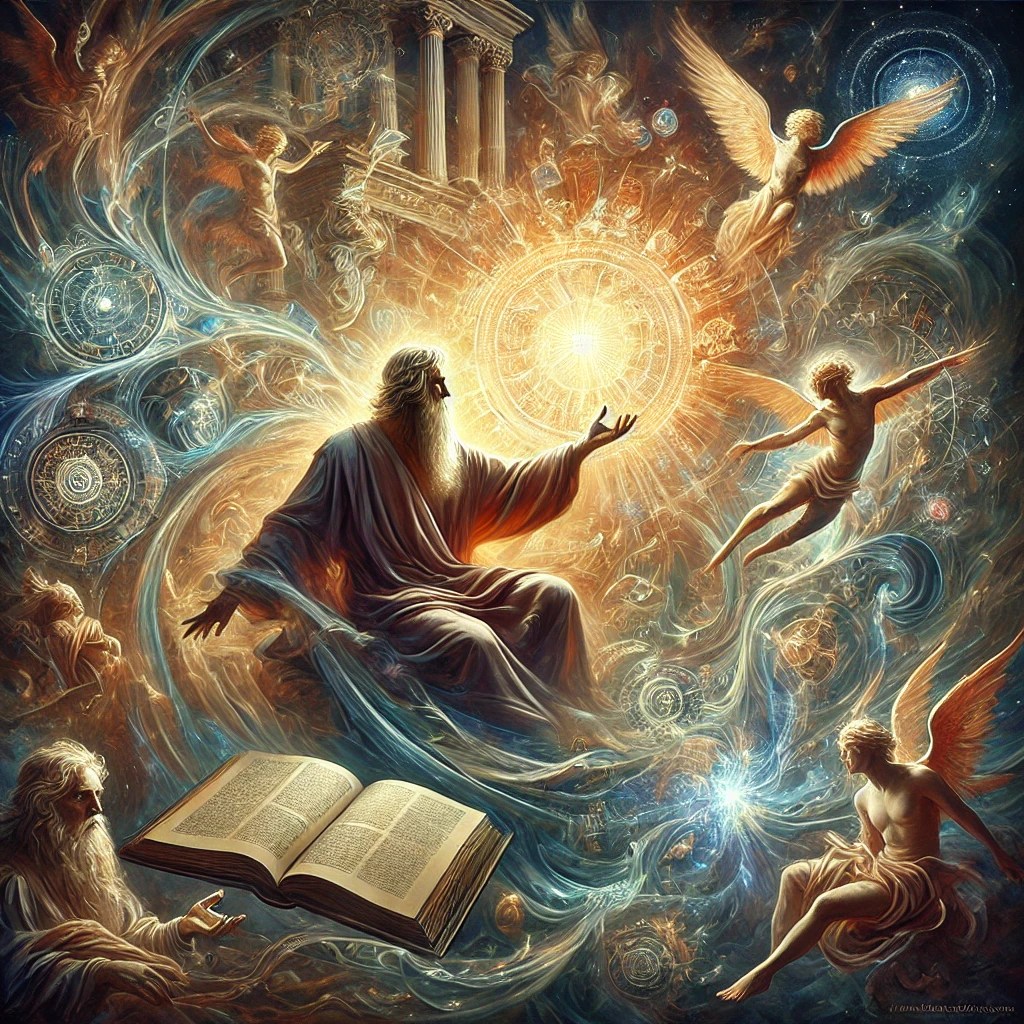
Visionary, Poet, and Mystic
William Blake stands as one of history’s most enigmatic and visionary figures—an artist, poet, and mystic whose work defied convention and sought to illuminate the hidden dimensions of reality. Born in 1757, Blake’s creative genius was shaped by profound spiritual visions, a deep engagement with biblical and mythological themes, and an unshakable belief in the power of imagination. Dismissed as eccentric or even mad during his lifetime, his influence has since grown, with modern scholars and artists recognizing him as a pioneer of visionary art and a prophet of the inner world.
Blake’s philosophy rejected materialism and the limitations of empirical reason, arguing instead that reality is fundamentally shaped by perception and imagination. His poetic and artistic works reflect an attempt to decode the unseen realms of existence, offering profound insights into human nature, spirituality, and the eternal struggle between order and chaos.
His dualistic vision of the world, most famously explored in Songs of Innocence and Experience, suggests that human understanding is forged through contrast—joy and suffering, light and darkness, innocence and wisdom. His work remains a powerful reminder that art, spirituality, and self-discovery are intimately connected, offering a roadmap for those seeking meaning beyond the visible world.
The Visionary World of Blake
🌌 Imagination as the Ultimate Reality – Blake believed that the imagination is not an escape from reality but its truest form. He saw perception as fluid, shaped not by external truths but by the mind’s ability to create meaning. This radical view challenged the dominant Enlightenment belief that reason alone could uncover reality, positioning imagination as a divine force capable of transforming human experience.
📖 A Mystic and a Seer – Throughout his life, Blake experienced visions of angels, spirits, and prophetic figures, which he interpreted as direct encounters with the divine. From childhood, he saw the world through a mythic and symbolic lens, perceiving hidden meanings behind everyday life. These experiences were not just mystical—they informed his artistic and poetic expression, making his work a bridge between the material and spiritual realms.
🔥 The Fourfold Vision – Blake proposed a hierarchy of perception, ranging from Single Vision (empirical reality) to Fourfold Vision (a mystical, transcendental awareness of divine unity). He argued that most people were trapped in narrow, materialistic thinking, unable to access the deeper layers of reality. His poetry and art were designed to expand perception, allowing individuals to glimpse the infinite world hidden within the finite.
Key Themes in Blake’s Work
🔄 Contraries and the Necessity of Opposition – A central idea in Blake’s philosophy is that opposites are not in conflict, but essential to growth. In The Marriage of Heaven and Hell, he famously states: “Without contraries is no progression”. He viewed good and evil, reason and passion, innocence and experience as necessary dualities, arguing that personal and spiritual development requires an engagement with both.
🌿 The Critique of Rationalism and Industrialization – Blake was a fierce critic of the scientific materialism and mechanization that dominated his era. He saw the rise of industrial society as a war against the human soul, enslaving people in a world devoid of imagination. His famous poem London describes the city as a prison of the mind, where “mind-forg’d manacles” restrict human potential. His rejection of blind rationalism resonates strongly today, as modern society grapples with the tension between technological progress and spiritual emptiness.
🎭 The Loss of Innocence and the Journey of Experience – Blake’s most famous collection, Songs of Innocence and Experience, explores the transition from childhood purity to the harsh realities of the adult world. The two halves of the collection contrast a world of joy, wonder, and divine presence with one of suffering, oppression, and spiritual loss. However, experience is not portrayed as evil, but as a necessary stage in awakening to deeper wisdom.
🌟 Prophetic Mythology and the Divine Human – Blake created an entire mythological system, weaving together biblical and mystical traditions with his own prophetic visions. His epic works, such as Jerusalem and Milton, depict a cosmic struggle between tyranny and liberation, oppression and divine creativity. He envisioned a future in which humanity awakens to its divine nature, breaking free from the chains of ignorance and repression.
Blake’s Spiritual Philosophy
💡 The Divine Within – Unlike religious dogma that placed God as an external force, Blake saw the divine as existing within every individual. He believed that the human imagination was a manifestation of God, arguing that creativity, love, and vision were sacred forces that connected people to the divine realm. His line, “To see a world in a grain of sand”, reflects this belief in the infinite within the finite.
🌀 The Shadow and the Self – Long before Carl Jung explored the shadow self, Blake was illustrating the necessity of integrating the darker aspects of the psyche. He saw figures like Satan not as external evils, but as manifestations of the fragmented human mind, embodying the struggles within each person. His philosophy suggests that true self-discovery requires embracing all aspects of our being, rather than repressing or denying them.
🎨 Art as a Spiritual Act – For Blake, art was not just an aesthetic pursuit—it was a divine calling. He saw his illuminated books as sacred works, meant to awaken readers to deeper truths. His unique style of combining poetry with intricate, visionary illustrations reflected his belief that true wisdom transcends words, requiring both image and text to convey spiritual truths.
Legacy and Influence
🔮 A Prophet Ahead of His Time – Though dismissed as eccentric in his lifetime, Blake’s ideas have profoundly influenced literature, psychology, and spiritual thought. His concepts of visionary perception, imagination as reality, and the divine within have inspired Romantic poets, depth psychologists, and modern mystics alike.
📖 Influence on Literature and Music – Blake’s work has shaped writers like Aldous Huxley, Allen Ginsberg, and Philip Pullman, as well as musicians including Bob Dylan, Patti Smith, and U2, who have drawn inspiration from his mystical themes and poetic vision.
💡 A Blueprint for Inner Awakening – Blake’s philosophy remains deeply relevant today, offering a counterbalance to modern materialism. His emphasis on spiritual imagination, personal vision, and the transformative power of creativity provides a powerful framework for those seeking a more profound, authentic connection with life.
Conclusion: The Enduring Vision of Blake
William Blake’s life was a testament to the power of imagination, inner vision, and artistic rebellion. His legacy serves as an invitation to see beyond the surface of reality, to embrace the mystical dimensions of existence, and to awaken to the divinity within. He reminds us that true perception is not about seeing with the eyes, but with the soul.
His prophetic words still resonate:
“If the doors of perception were cleansed, everything would appear to man as it is, infinite.”
Blake’s vision continues to inspire those who seek meaning beyond the material world, who dare to embrace their inner genius, and who believe that creativity is not just an act—but a sacred path to the divine.


 alter your perspective
Leave a comment